As protests and repression intensify inside Iran, Beijing finds itself under growing pressure. China’s long-standing principle of non-interference is colliding with its deep economic entanglement with the Islamic Republic.
When US President Donald Trump warned that Tehran would face “serious consequences” if protesters were killed, China initially stayed silent. When it did respond, it repeated familiar positions, calling for calm, opposing outside interference and restating views it said it had “always” held.
That posture shifted on Tuesday, when Trump announced an additional 25 percent tariff on countries that continue to defy Washington’s policy on Iran. The measure was to take effect “definitively” and “immediately”, and was aimed above all at China, Iran’s most important trading partner.
Beijing said it would “resolutely defend its legitimate rights and interests”, reject foreign military intervention in Iran and act as needed to protect Chinese citizens.
[…]
Why China can absorb Iranian oil
Estimates suggesting that more than 90 percent of Iranian oil exports go to China are plausible, said Didier Chaudet, an expert in geopolitics, specialising in Persian-speaking regions.
“If we look at Iran’s other potential customers, we see countries that do not have the means for abundant consumption, such as Afghanistan at present, or Syria until the fall of the Assad regime,” Chaudet said.
Others, such as Turkey, “do not have the political will, for fear of provoking American wrath”.
That leaves China as “the only country with the political will, economic need and financial capacity to absorb the majority of Iranian oil”, Chaudet added.
Around a quarter of that oil is processed in so-called teapot refineries, small semi-independent facilities known for handling sanctioned crude from Iran or Venezuela.
China is increasingly assuming responsibility for this trade through forums such as BRICS+ and the Shanghai Cooperation Organisation, both of which Iran has joined, Chaudet said.
“It is a way to criticise the latest sanctions imposed on Iran, which are considered excessive and even illegal,” he said.
Buying Iranian oil beyond China’s immediate needs is also “a way of helping the regime to stabilise”, Chaudet said. Many Chinese researchers fear that if the regime collapses, Iran could become “a greater Syria rather than a greater Sweden”.
[…]
Support, but with limits
Beijing’s support for Tehran is not unconditional. Chaudet said Iranian perceptions of Russia and China are increasingly diverging.
“Moscow has not lived up to the expected level of support,” he said, despite Tehran’s alignment with the Kremlin over Ukraine.
China, however, “is not in a position of absolute support”, Chaudet said. Chinese analysts are aware of the Iranian regime’s weaknesses and are “not receptive” to Tehran’s calls for greater assistance.
“Iran is a partner, certainly, but not at the heart of China’s national interests,” he said. “China will not go into conflict with Washington to save Tehran.”
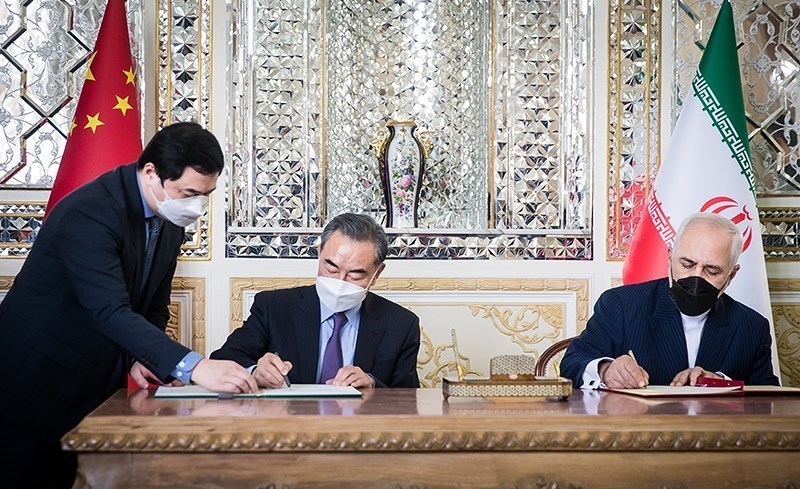
© Iranian Foreign Minister Mohammad Javad Zarif and Chinese Foreign Minister Wang Yi signed a document on Iran–China 25-year Cooperation Program. Wikimedia Commons